What Is Bovine Colostrum?
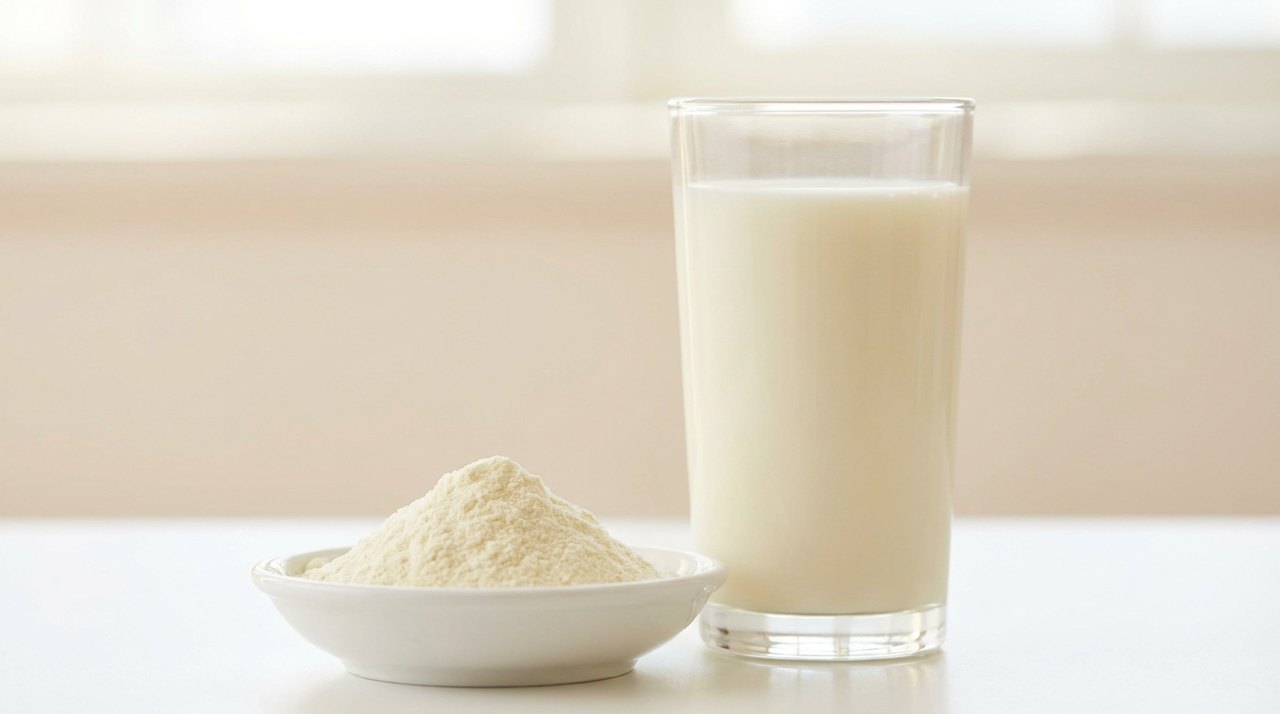
Colostrum is the thick, yellowish "first milk" that mammals — including cows and humans — produce in the first few days after giving birth. It is biologically different from the mature milk that follows: far more protein, a large dose of antibodies, and a set of growth factors that regular milk barely contains. That difference is the whole reason it ends up in a supplement jar.
- Colostrum is milk from roughly the first 1–3 days after calving, not a synthetic product or an extract.
- It contains several times the protein of regular milk and dozens of times the immunoglobulin (IgG), plus lactoferrin, growth factors and proline-rich polypeptides.
- Supplements are almost always bovine (from cows), pasteurized and dried into powder or capsules.
- Products differ mainly by IgG percentage, collection window, processing temperature and sourcing — two jars labeled "colostrum" are not equal.
- The evidence base is moderate for gut-barrier and respiratory-illness outcomes in specific groups, and thin or preliminary for most other marketing claims.
The "first milk" idea
In the first 24–72 hours after birth, mammary glands produce colostrum before transitioning to regular (mature) milk. For a newborn calf, colostrum is less about calories and more about a concentrated delivery of antibodies, immune proteins and growth factors. Calves are born with essentially no circulating antibodies of their own, so they depend on absorbing immunoglobulins from colostrum during a short window in which the gut lining lets large proteins through. That window closes within about a day, and the milk's composition shifts toward the familiar profile of drinking milk.
This is why dairy science talks about "first milking" and "second milking" colostrum. The very first milking after calving has the highest concentration of immunoglobulins; each subsequent milking dilutes it. Supplement makers who specify a collection window (for example, "collected within the first 24 hours") are telling you where in that curve their raw material came from.
Colostrum vs regular milk: the numbers
The clearest way to see what makes colostrum different is to put it next to mature milk. The ranges below are approximate, drawn from dairy-science reviews of first-milking bovine colostrum; individual cows, breeds and milkings vary a great deal.
| Component (per liter, approx.) | First-milking colostrum | Mature milk |
|---|---|---|
| Total protein | approx. 140–150 g (14–15%) | approx. 32 g (3.2%) |
| Immunoglobulin G (IgG) | approx. 30–80 g | approx. 0.5–1 g |
| Lactoferrin | approx. 1–2 g (sometimes higher) | approx. 0.1–0.3 g |
| Fat | approx. 60 g (6%) | approx. 35–40 g (3.5–4%) |
| Lactose | approx. 25 g (2.5%) | approx. 45–50 g (4.5–5%) |
| Growth factors (IGF-1, TGF-β) | Present at meaningful levels | Trace |
Two things stand out. Colostrum has roughly four to five times the protein of milk, and most of that extra protein is immunoglobulin rather than casein. And it actually has less lactose than milk, which is one reason some lactose-sensitive people tolerate small doses better than they expect — though it is not lactose-free. We go deeper on this comparison in colostrum vs regular milk.
Why bovine (cow) colostrum?
The colostrum sold as a supplement is almost always bovine, from cows. There are two practical reasons. First, dairy farming already produces colostrum at scale, and a cow makes far more than a single calf needs in those first days. Second, bovine colostrum is rich in the same broad categories of bioactive compounds found in human colostrum, and the immunoglobulins in it are largely resistant to digestion in the stomach, which is what makes oral supplementation plausible in the first place.
Responsible producers collect colostrum only after the calf has had its share, so the newborn is not deprived. When you are shopping, sourcing like this is a reasonable thing to look for; we cover the ethics question separately in is bovine colostrum ethical? and the farming side in grass-fed vs conventional colostrum.
Bovine vs human colostrum
People sometimes assume bovine colostrum is a stand-in for human breast milk. It is not, and the differences matter for understanding what a supplement can and cannot do.
- Antibody type. Human colostrum is dominated by secretory IgA, which coats mucosal surfaces. Bovine colostrum is dominated by IgG, because cows transfer immunity to calves almost entirely through colostrum rather than across the placenta.
- Concentration. Bovine colostrum is far more concentrated in IgG than human colostrum, which is why it is the species of choice for supplements.
- Antibody specificity. A cow's antibodies reflect the pathogens the cow has been exposed to. Many are relevant to common gut microbes, but this is not "immunity in a bottle" for humans.
- Purpose. Bovine colostrum supplements are not a substitute for infant feeding and should never be given to infants in place of breast milk or formula.
What's actually in it
Colostrum is a complex mixture, but a handful of components get most of the attention. Each has its own page on this site if you want the detail.
- Immunoglobulins (IgG, IgA, IgM) — antibodies that are the headline ingredient. IgG is the most abundant in bovine colostrum, and many supplements advertise a guaranteed IgG percentage.
- Lactoferrin — an iron-binding protein studied for its antimicrobial and immune-modulating activity in laboratory and clinical research.
- Growth factors — such as IGF-1 and TGF-β, which are involved in tissue repair and maintenance of the gut lining.
- Proline-rich polypeptides (PRPs) — small peptides studied for their role in immune signaling.
- Other proteins — casein, whey proteins (β-lactoglobulin, α-lactalbumin), lysozyme and lactoperoxidase.
- Oligosaccharides, vitamins and minerals — modest amounts; colostrum is not a meaningful source of micronutrients at supplement doses.
Colostrum vs whey vs collagen
Because colostrum is sold as a powder next to protein supplements, it gets compared to whey and collagen. They are different tools for different jobs.
| Colostrum | Whey protein | Collagen peptides | |
|---|---|---|---|
| What it is | Dried first milk, whole food | Protein fraction isolated from milk | Hydrolyzed connective-tissue protein |
| Protein per serving | Low (approx. 2–3 g per 5 g scoop) | High (20–25 g per scoop) | Moderate (10–20 g) |
| Immunoglobulins | High (the point of the product) | Trace | None |
| Growth factors, lactoferrin, PRPs | Present | Minimal | None |
| Typical use | Gut and immune support | Muscle protein, satiety | Skin, joints, connective tissue |
| Dairy allergens | Yes | Yes | No |
If you want protein, buy protein. Colostrum is taken in small doses for its bioactive fraction, not for grams of protein. We compare the first two in more depth in colostrum vs whey protein and look at the skin angle in colostrum for skin and collagen.
How a supplement is made
After collection, liquid colostrum is typically pasteurized for safety and then dried into a powder, most often by spray-drying or freeze-drying, so it is shelf-stable. From there it is sold as loose powder or packed into capsules. Some products are also defatted (skimmed) to improve mixability and shelf life. Because heat can degrade delicate proteins and antibodies, lower-temperature processing is often promoted as a way to preserve more of the bioactive content. The full process, step by step, is in from farm to powder: how colostrum supplements are made. Whether the powder or capsule format suits you better is covered in powder vs capsules.
How to read IgG % on a label
The single most useful number on a colostrum label is the IgG percentage, because it tells you how concentrated the product is. Roughly:
- 15–20% IgG is typical of standard whole colostrum powder from a reasonable collection window.
- 25–40% IgG indicates first-milking material and often some concentration or defatting.
- Above 40% usually means a concentrated or fractionated product.
To compare products, multiply the serving size by the IgG percentage: a 5 g serving at 20% IgG delivers about 1 g of IgG, the same as a 2.5 g serving at 40%. A label that shows no IgG figure at all, or only says "standardized," gives you no way to make that comparison. Our how to choose a colostrum supplement guide walks through the rest of the label, and dosage and safety covers how those grams translate into a daily amount.
Now that you know what it is, the natural next questions are what it might do and how to choose a good one.
Frequently asked questions
Is colostrum just concentrated milk?
No. It is a distinct secretion produced only in the days after calving, with a different protein profile: several times more protein, most of it immunoglobulin, plus growth factors and lactoferrin at levels mature milk does not reach. Concentrating regular milk would raise casein and lactose, not IgG.
Is bovine colostrum the same as breast milk?
No. Human colostrum is rich in secretory IgA; bovine colostrum is dominated by IgG and is much more concentrated. Bovine colostrum supplements are not a replacement for infant feeding.
Does colostrum contain lactose?
Yes, though less than regular milk (roughly half as much per liter). A typical 5 g serving contains only a gram or so of lactose. People with a true milk allergy should avoid it entirely; people with lactose intolerance often tolerate small doses but should start low.
Is colostrum a protein powder?
Not really. A 5 g serving provides only a few grams of protein. It is taken for its immunoglobulins, lactoferrin, growth factors and peptides, not as a protein source.
What does "first milking" mean on a label?
It means the colostrum was collected at the first milking after calving, when IgG concentration is highest. Later milkings contain progressively less IgG, so the phrase is a rough quality signal.
Sources
- Playford RJ, Weiser MJ. Bovine Colostrum: Its Constituents and Uses. Nutrients. 2021;13(1):265.
- McGrath BA, Fox PF, McSweeney PLH, Kelly AL. Composition and properties of bovine colostrum: a review. Dairy Science & Technology. 2016;96:133–158.
- Rathe M, Müller K, Sangild PT, Husby S. Clinical applications of bovine colostrum therapy: a systematic review. Nutrition Reviews. 2014;72(4):237–254.
- Ulfman LH, Leusen JHW, Savelkoul HFJ, Warner JO, van Neerven RJJ. Effects of Bovine Immunoglobulins on Immune Function, Allergy, and Infection. Frontiers in Nutrition. 2018;5:52.
- Hałasa M, Maciejewska D, Baśkiewicz-Hałasa M, et al. Oral Supplementation with Bovine Colostrum Decreases Intestinal Permeability and Stool Concentrations of Zonulin in Athletes. Nutrients. 2017;9(4):370.
- Davison G. The Use of Bovine Colostrum in Sport and Exercise. Nutrients. 2021;13(6):1789.
- Bagwe S, Tharappel LJP, Kaur G, Buttar HS. Bovine colostrum: an emerging nutraceutical. Journal of Complementary and Integrative Medicine. 2015;12(3):175–185.