Colostrum Dosage & Safety
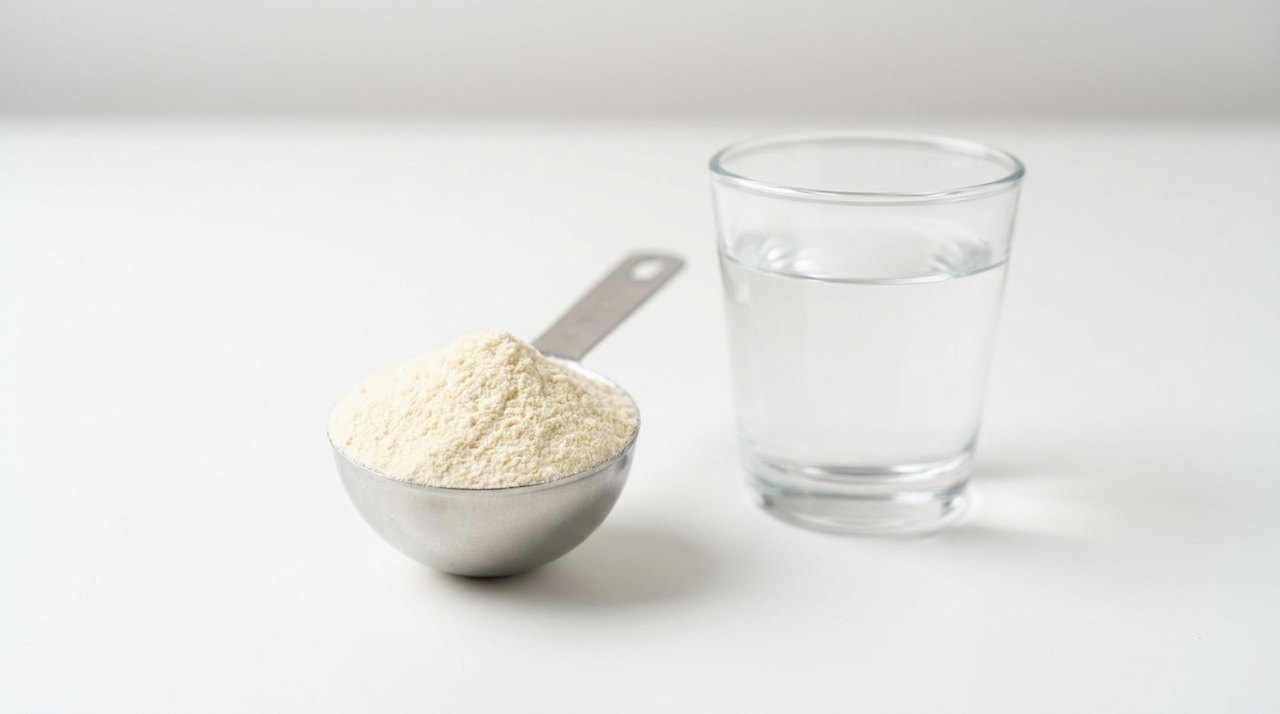
There is no official recommended dose for bovine colostrum. Clinical studies have used anywhere from under a gram to 60 grams a day, and product labels range from half a gram to 10 grams. This page lays out what those ranges mean, how to pick a starting point for your goal, when to take it, what side effects to expect, and who should skip it or talk to a doctor first.
- Most people start at 1–3 g per day and settle between 2–10 g depending on the goal; athlete and gut-permeability studies have used 10–20 g or more.
- Compare products by IgG delivered, not by grams of powder: 5 g at 20% IgG equals 2.5 g at 40% IgG.
- Timing has no strong evidence behind it. Empty stomach is common; with food is fine if it upsets your stomach.
- Side effects are usually mild and digestive. Milk allergy is the one clear reason to avoid it entirely.
- Give it 4–8 weeks of consistent use before judging whether it does anything for you.
Typical doses by goal
The table below summarizes what product labels commonly suggest and what published studies have used. Doses are grams of whole colostrum powder per day. These are reference points, not prescriptions; follow your label and your provider's guidance.
| Goal | Common label range | Range used in studies | Approx. IgG at 20% product |
|---|---|---|---|
| General wellness / daily maintenance | 1–3 g | Few studies at this level | 0.2–0.6 g |
| Gut-barrier support | 2–10 g | approx. 0.5–20 g | 0.4–2 g |
| Athletes (training stress, gut permeability, URTI) | 10–20 g | 10–60 g | 2–4 g |
| Children (research settings only) | Not labeled | approx. 3 g in pediatric trials | 0.6 g |
A few notes on reading that table. The athlete figures come from trials in which colostrum was taken as a bulk protein supplement, often 20 g or more per day, for weeks. The gut-permeability work is more mixed: one Polish trial in athletes used 500 mg twice daily and reported reduced permeability markers, while older British work used 20 g a day. Pediatric trials from India and Iran have used about 3 g daily, but that is research under medical supervision, not a home dose. If you are shopping for a child, read the cautions section first.
Grams vs IgG: what you are actually dosing
"Five grams" of colostrum means different things depending on concentration. IgG percentage, explained in what is colostrum, is the number that lets you compare. Multiply serving size by IgG percentage:
- 5 g at 20% IgG = about 1 g IgG
- 2.5 g at 40% IgG = about 1 g IgG
- 1 g at 25% IgG = about 0.25 g IgG
This is why a 1 g serving of a concentrated product and a 5 g serving of a standard product can be broadly comparable, and why a product that does not state its IgG content is hard to dose sensibly. Our how to choose guide covers what else to check on the label, and immunoglobulins explained covers what IgG actually does.
Loading vs maintenance
Some brands suggest a higher "loading" dose for the first 1–2 weeks followed by a lower maintenance dose. There is no trial evidence that loading changes outcomes; it is a marketing convention borrowed from creatine. A more defensible approach is the opposite: start low to check tolerance, then increase.
- Week 1: half the label serving, once a day.
- Week 2: the full label serving.
- Weeks 3 onward: hold, or increase toward the upper label range if you are targeting a specific goal and tolerating it well.
Do not exceed the label's maximum without talking to a provider. Higher doses cost more and, past a point, mostly add protein rather than benefit. A day-by-day routine is in the daily routine guide.
When to take it
Timing is the most asked and least studied question about colostrum. Here is what can honestly be said.
Empty stomach or with food?
Many labels say "on an empty stomach," on the theory that less stomach acid and fewer competing proteins mean more intact immunoglobulins reach the gut. Bovine IgG is fairly resistant to digestion either way, and no human trial has compared the two conditions on a meaningful outcome. If an empty stomach upsets your digestion, take it with food and lose nothing you can measure.
Morning or night?
No evidence favors one. Pick the time you will remember consistently. Some people report that taking it at night makes them feel slightly full or bloated; if so, move it to the morning. We look at the sleep question separately in colostrum, stress and sleep.
Does it break a fast?
Technically yes: a 5 g scoop has roughly 15–20 calories and a few grams of protein, which is enough to end a strict fast. For most 16:8-style time-restricted eating the effect is minor, and for keto it is a non-issue. The full breakdown, including which fasting styles it matters for, is in does colostrum break a fast?
Around training
Athlete studies generally split the daily amount into two doses, morning and evening, or took it after training. Consistency across weeks mattered more than the clock time.
How long before you judge it
Colostrum effects, where they occur, are gradual. Trials that reported changes in gut permeability or illness days ran for 4–12 weeks. A fair personal trial is 4–8 weeks of daily use at a consistent dose, with one or two concrete things you are watching: digestive comfort, bowel regularity, how you recover from hard training, or how often you catch colds over a season. If you notice nothing after eight weeks, it is reasonable to stop. Colostrum is not a supplement that needs to be taken forever to "work," and cycling on and off is fine.
Possible side effects
Bovine colostrum is generally well tolerated in trials, including at doses of 20–60 g a day. Side effects, when reported, are usually mild and digestive:
- Gas, bloating, loose stools — the most common, especially in the first week or at higher doses. Usually eases with time or a lower dose.
- Nausea — occasionally, more often on an empty stomach.
- Skin breakouts — anecdotally reported online, plausibly linked to dairy hormones and growth factors in people prone to acne. Not documented in trials, but worth a pause if you notice it.
- Constipation — reported by a minority; increasing water intake typically resolves it. See colostrum, constipation and diarrhea.
A detailed rundown of what has and has not been reported is in colostrum side effects. If you have a reaction that looks allergic (hives, swelling, wheezing), stop immediately and seek medical care.
Who should be cautious or avoid it
- Milk or dairy allergy: colostrum contains casein and whey proteins and can trigger allergic reactions. Avoid it. This is different from lactose intolerance, which is an enzyme issue, not an immune one.
- Lactose intolerance: colostrum has less lactose than milk (about a gram per 5 g serving). Many people tolerate it; start with a small dose, or look for a defatted or lactose-reduced product.
- Pregnant or nursing: there is no safety data. Talk to your provider before starting.
- Infants and children: never as a substitute for breast milk or formula. For older children, only under pediatric guidance; see the dosing table for what trials have used.
- Immunocompromised or on immunosuppressants: colostrum is an immune-active product; discuss it with the physician managing your condition before use.
- Autoimmune conditions: no evidence of harm, but no evidence of safety either. Involve your specialist.
- Insulin-like growth factor concerns: colostrum contains IGF-1. Oral IGF-1 is largely digested, and trials have not shown meaningful changes in blood IGF-1, but anyone advised to avoid growth-factor exposure should raise it with their doctor.
Interactions
No formal drug-interaction studies exist for bovine colostrum. Two practical points:
- Timing with medications. Like any dairy product, colostrum can bind some antibiotics (tetracyclines, fluoroquinolones) and reduce absorption. Separate doses by two hours.
- Other supplements. Colostrum is routinely taken alongside probiotics, whey, creatine and vitamins without reported problems. There is no evidence it enhances or blocks them.
Long-term use
Most trials run 4–12 weeks, so "safe for years" is an extrapolation rather than a finding. Colostrum is a food, has a long history of use in dairy-farming cultures, and has not produced safety signals in the research to date. Sensible practice is to reassess every few months: if it is still doing something you can point to, continue; if not, stop or take a break. There is no evidence of dependence or rebound effects when stopping.
None of this is a substitute for professional advice. If you are unsure whether colostrum fits your situation, ask a qualified healthcare provider.
Frequently asked questions
How much colostrum should I take per day?
Most adults start at 1–3 g a day and settle between 2 and 10 g depending on the goal. Athlete studies used 10–20 g or more. Follow your product's label and compare products by IgG content rather than grams.
Can I take too much colostrum?
Trials have used up to 60 g a day without serious adverse effects, but high doses mainly add cost and digestive side effects. Stay within your label's maximum unless a provider advises otherwise.
Should I take colostrum on an empty stomach?
It is the common recommendation, but no trial shows it matters. If an empty stomach causes nausea or bloating, take it with food.
Can I take colostrum at night?
Yes. There is no evidence that time of day changes its effects. Take it whenever you will remember consistently.
How long does colostrum take to work?
Give it 4–8 weeks of daily use. Effects, where they happen, are gradual rather than immediate.
Is colostrum safe for lactose-intolerant people?
Often, in small doses: it contains less lactose than milk, about a gram per 5 g serving. Start low. A true milk allergy is different and means you should not take it at all.
Sources
- Rathe M, Müller K, Sangild PT, Husby S. Clinical applications of bovine colostrum therapy: a systematic review. Nutrition Reviews. 2014;72(4):237–254.
- Playford RJ, Weiser MJ. Bovine Colostrum: Its Constituents and Uses. Nutrients. 2021;13(1):265.
- Hałasa M, Maciejewska D, Baśkiewicz-Hałasa M, et al. Oral Supplementation with Bovine Colostrum Decreases Intestinal Permeability and Stool Concentrations of Zonulin in Athletes. Nutrients. 2017;9(4):370.
- Marchbank T, Davison G, Oakes JR, et al. The nutriceutical bovine colostrum truncates the increase in gut permeability caused by heavy exercise in athletes. American Journal of Physiology – Gastrointestinal and Liver Physiology. 2011;300(3):G477–G484.
- Davison G. The Use of Bovine Colostrum in Sport and Exercise. Nutrients. 2021;13(6):1789.
- Brinkworth GD, Buckley JD. Concentrated bovine colostrum protein supplementation reduces the incidence of self-reported symptoms of upper respiratory tract infection in adult males. European Journal of Nutrition. 2003;42(4):228–232.
- Ulfman LH, Leusen JHW, Savelkoul HFJ, Warner JO, van Neerven RJJ. Effects of Bovine Immunoglobulins on Immune Function, Allergy, and Infection. Frontiers in Nutrition. 2018;5:52.