What Is Colostrum Made Of? Full Composition Breakdown (Proteins, Fats, Sugars)
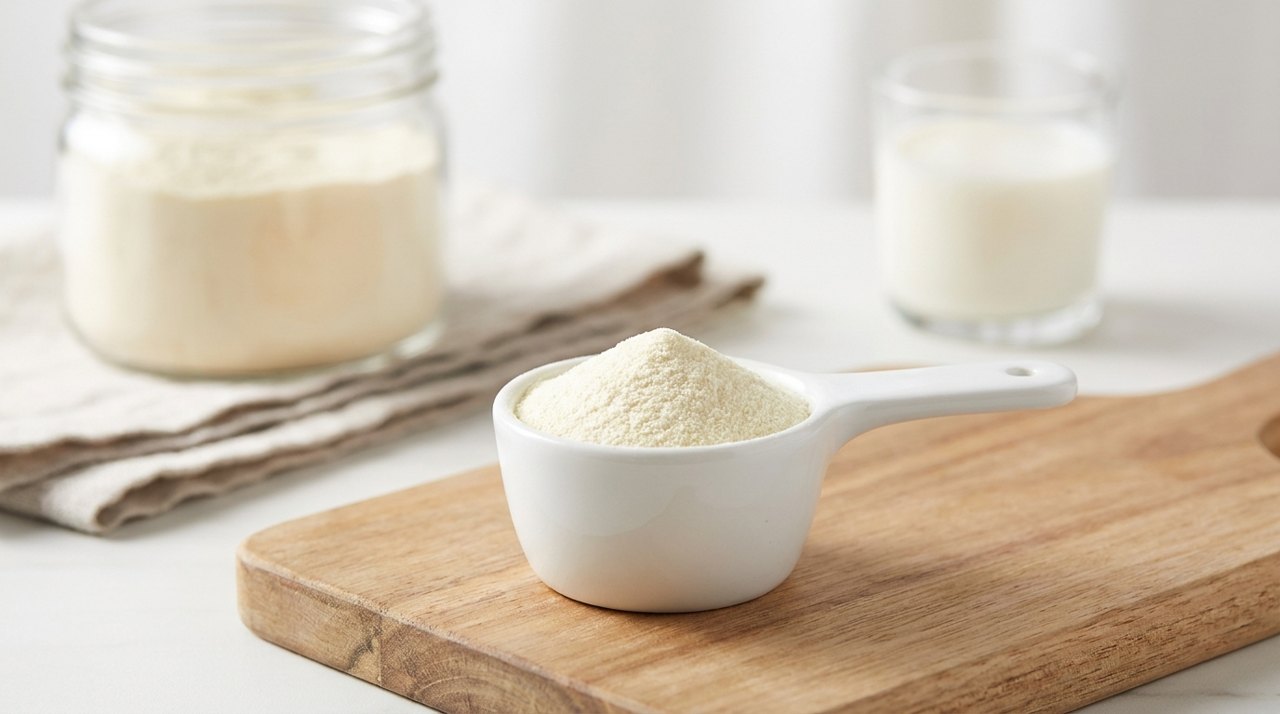
Bovine colostrum is the first secretion a cow produces after calving, and it is chemically very different from the milk that follows a few days later. It carries roughly twice the solids, three to five times the protein, and only about half the lactose of mature milk, along with a dense payload of immunoglobulins, lactoferrin, growth factors and oligosaccharides. This article breaks down what is actually in colostrum, gram by gram, and how those numbers change once it is dried into a supplement powder.
Key takeaways
- First-milking colostrum is roughly 24% solids by weight, versus about 13% for mature milk.
- Protein is the standout: around 14 g per 100 g, of which immunoglobulins (mainly IgG) can make up 40% or more.
- Fat is higher than in milk (about 6–7%), lactose is lower (about 2.5–3%), and oligosaccharides are 10 to 20 times more concentrated.
- Composition drops fast: by the third or fourth milking most values are close to ordinary milk.
- Supplement powders vary widely; IgG content (typically 15–40%) and fat level are the two numbers that matter most on a label.
The big picture: colostrum versus mature milk
The clearest way to understand colostrum is to line it up against the milk the same cow produces a week later. The figures below are widely cited averages from dairy science literature (Foley and Otterby's classic dataset, later summarised by McGrath and colleagues). Individual cows, breeds, parity and the interval between calving and first milking all shift these numbers, sometimes substantially.
| Component (per 100 g) | First milking colostrum | Transition milk (milking 2–3) | Mature milk |
|---|---|---|---|
| Total solids | ~23.9 g | ~15–18 g | ~12.9 g |
| Total protein | ~14.0 g | ~5–8 g | ~3.1 g |
| Immunoglobulins | ~6.0 g | ~1–4 g | ~0.09 g |
| Casein | ~4.8 g | ~3–4 g | ~2.5 g |
| Fat | ~6.7 g | ~4–5 g | ~4.0 g |
| Lactose | ~2.7 g | ~3.5–4.5 g | ~5.0 g |
| Minerals (ash) | ~1.1 g | ~0.9 g | ~0.7 g |
| Approx. energy | ~125 kcal | ~80–95 kcal | ~65 kcal |
Two things stand out. First, colostrum is energy-dense mainly because of protein and fat, not sugar. Second, the immunoglobulin fraction alone is larger than the entire protein content of mature milk. If you are new to the topic, our overview of what colostrum is covers the biology behind why the cow front-loads these compounds.
Shopping for colostrum? Our current best-value pick is BIOMIXA grass-fed colostrum powder on Amazon.
Proteins: the defining fraction
Milk proteins are conventionally split into caseins and whey proteins. In mature milk, casein dominates at roughly 80% of protein. In colostrum, the ratio flips: whey proteins, driven almost entirely by immunoglobulins, account for the majority.
Immunoglobulins
Immunoglobulins (antibodies) are the reason colostrum exists. A newborn calf has essentially no circulating antibodies and absorbs them from colostrum during its first day of life. Bovine colostrum contains three main classes:
- IgG makes up roughly 85–90% of total immunoglobulin. IgG1 is the dominant subclass. Concentrations in first-milking colostrum commonly range from 30 to 80 g/L, with a large farm survey reporting a mean near 35 g/L and values below 50 g/L in a substantial share of samples.
- IgM accounts for about 7% and is present at around 3–5 g/L.
- IgA accounts for about 5%, at roughly 2–4 g/L. This differs from human colostrum, where IgA dominates.
Because IgG is abundant and easy to assay, supplement makers use it as the standardisation marker. Whether the IgG in a powder survives digestion in a meaningful, active form in adults is an open question. Some studies detect intact IgG in stool after oral dosing, but the evidence that this translates into a functional benefit in healthy adults is limited.
Lactoferrin, lactoperoxidase and lysozyme
Lactoferrin is an iron-binding glycoprotein found at roughly 1.5–5 g/L in colostrum versus 0.1–0.3 g/L in mature milk. It is studied for iron-binding and antimicrobial properties in vitro, though human data on oral supplementation is mixed. Lactoperoxidase and lysozyme are present at far lower levels but contribute to the protective enzyme system of the secretion.
Caseins and other whey proteins
Casein is still present, at about 4.8 g per 100 g, and provides most of the amino acids a calf uses for growth. The classic whey proteins beta-lactoglobulin and alpha-lactalbumin are also elevated relative to milk. For people with a milk protein allergy, these fractions are why colostrum is not a safe alternative, a point covered in more detail on our dosage and safety page.
Growth factors and peptides
Colostrum contains a range of peptide growth factors at concentrations far above those in milk. Reported ranges include insulin-like growth factor 1 (IGF-1) at roughly 50–2,000 µg/L in colostrum versus under 10 µg/L in milk, and transforming growth factor beta 2 (TGF-β2) at about 150–1,150 µg/L. These figures vary enormously between studies and are sensitive to heat processing. Their physiological relevance after oral ingestion in adults has not been established.
Fats: more of it, and a different profile
Fat in first-milking colostrum averages around 6.7% but ranges from under 3% to over 10% depending on the cow. About 97–98% of that fat is triglycerides, with the remainder being phospholipids, cholesterol and fat-soluble vitamins. The fat globules are wrapped in the milk fat globule membrane (MFGM), which carries phospholipids such as sphingomyelin and phosphatidylcholine, plus membrane proteins.
Colostrum fat is somewhat richer in long-chain fatty acids and lower in short-chain fatty acids than mature milk fat, and it carries proportionally more conjugated linoleic acid (CLA). It is also the main vehicle for vitamin A, which is several times more concentrated in colostrum than in milk (values near 300 µg per 100 g versus roughly 35 µg are commonly cited), along with vitamin E and beta-carotene.
For supplement buyers, the practical issue is that fat is often removed. Whole (full-fat) colostrum powder may contain 15–25% fat, while defatted or skimmed powders drop to 1–5%. Removing fat concentrates the protein and IgG and improves shelf life, but strips out MFGM lipids and fat-soluble vitamins.
Sugars: less lactose, far more oligosaccharides
Lactose is the main sugar in both colostrum and milk, but colostrum contains only about half as much, roughly 2.5–3 g per 100 g against 5 g in mature milk. This lower lactose level is one reason the fluid is so thick: lactose is the primary osmotic regulator of milk volume, and less of it means less water drawn into the secretion.
The more interesting sugars are the free oligosaccharides. Bovine colostrum contains roughly 0.7–1.2 g/L of these, versus only 0.03–0.06 g/L in mature milk. The profile is dominated by sialylated species, especially 3'-sialyllactose, 6'-sialyllactose and 6'-sialyllactosamine. These are studied as prebiotic substrates for gut bacteria and as potential decoy receptors for pathogens, though most of the work is in cell culture and animal models. Bovine oligosaccharides are far less diverse and less abundant than human milk oligosaccharides, so extrapolations from infant nutrition research should be treated cautiously.
Because supplement powders are made from the whole secretion, lactose remains present, typically at 15–30% of powder weight. This matters if you are lactose intolerant, though a standard 1–3 g serving delivers well under 1 g of lactose.
Minerals and vitamins
Colostrum has a higher mineral content than milk, with ash around 1.1% versus 0.7%. Calcium, phosphorus, magnesium, zinc, copper and iron are all elevated, roughly 1.5 to 3 times mature-milk levels in the first milking. Water-soluble vitamins such as riboflavin and B12 are also higher, while vitamin C is modest in both. These contributions are meaningful for a calf drinking litres of the fluid, but trivial at typical human supplement doses of a few grams.
What ends up in a supplement powder
Spray-drying or freeze-drying removes water, so a powder is essentially the solids from the table above, concentrated four to five times. Processing choices then determine the final profile. The comparison below uses representative label ranges; always check the certificate of analysis for a specific product.
| Powder type | Protein | IgG | Fat | Lactose | Energy (per 1 g) |
|---|---|---|---|---|---|
| Whole (full-fat) colostrum | 40–55% | 15–25% | 15–25% | 15–25% | ~4.5–5 kcal |
| Defatted / skimmed colostrum | 55–70% | 20–30% | 1–5% | 20–30% | ~3.5–4 kcal |
| IgG-standardised concentrate | 65–80% | 30–40%+ | 1–10% | 5–15% | ~4 kcal |
Heat is the other variable. Pasteurisation at 72 °C for 15 seconds causes only modest IgG losses, but harsher heat treatments and prolonged holding can denature 20–40% or more of the immunoglobulins and most of the labile growth factors. This is why "low-heat" or "flash-pasteurised" claims appear on labels. Our guide to choosing a colostrum supplement walks through how to weigh IgG percentage, fat content and processing claims against each other.
FAQ
How much IgG is in a typical serving?
A 1 g serving of a powder standardised to 20% IgG delivers about 200 mg of IgG, and a 3 g serving about 600 mg. For comparison, a calf consumes 100–200 g of IgG in its first feeds. Human trials have used anywhere from 500 mg to 60 g of colostrum daily, so there is no established "correct" dose for adults.
Does colostrum contain lactose?
Yes. Fresh colostrum contains roughly half the lactose of milk, and powders typically carry 15–30% lactose by weight. A standard serving of a few grams therefore provides well under a gram of lactose, which many lactose-intolerant people tolerate, but individual sensitivity varies and colostrum is not suitable for anyone with a milk protein allergy.
Why does colostrum composition vary so much between sources?
Breed, the cow's age and number of previous calvings, vaccination history, diet, and especially the time between calving and first milking all affect concentrations. IgG in first milkings can range from under 20 g/L to over 100 g/L. Pooling from many cows and standardising to a target IgG level is how manufacturers smooth out this variability.
Are the growth factors in colostrum a concern?
IGF-1 and related peptides are present at much higher levels than in milk, but they are proteins that are largely digested in the adult gut. Studies measuring blood IGF-1 after colostrum supplementation have generally found little or no change. That said, the long-term data is thin, and anyone with a hormone-sensitive condition should discuss supplements with a clinician.
Sources
- McGrath BA, Fox PF, McSweeney PLH, Kelly AL. Composition and properties of bovine colostrum: a review. Dairy Science & Technology. 2016;96:133–158.
- Playford RJ, Weiser MJ. Bovine colostrum: its constituents and uses. Nutrients. 2021;13(1):265.
- Kehoe SI, Jayarao BM, Heinrichs AJ. A survey of bovine colostrum composition and colostrum management practices on Pennsylvania dairy farms. Journal of Dairy Science. 2007;90(9):4108–4116.
- Elfstrand L, Lindmark-Månsson H, Paulsson M, Nyberg L, Åkesson B. Immunoglobulins, growth factors and growth hormone in bovine colostrum and the effects of processing. International Dairy Journal. 2002;12(11):879–887.
- Godhia ML, Patel N. Colostrum: its composition, benefits as a nutraceutical – a review. Current Research in Nutrition and Food Science. 2013;1(1):37–47.
BIOMIXA Bluegrass Colostrum
A grass-fed, unflavored colostrum powder that balances quality and price well — our pick for the best bang for your buck. Check the current price and reviews on Amazon.
Disclosure: BIOMIXA is our own brand — this site is run by the makers of BIOMIXA colostrum. We also earn a commission on Amazon purchases. Full disclosure.