Bovine Colostrum for Dogs: What Pet Owners Should Know Before Buying
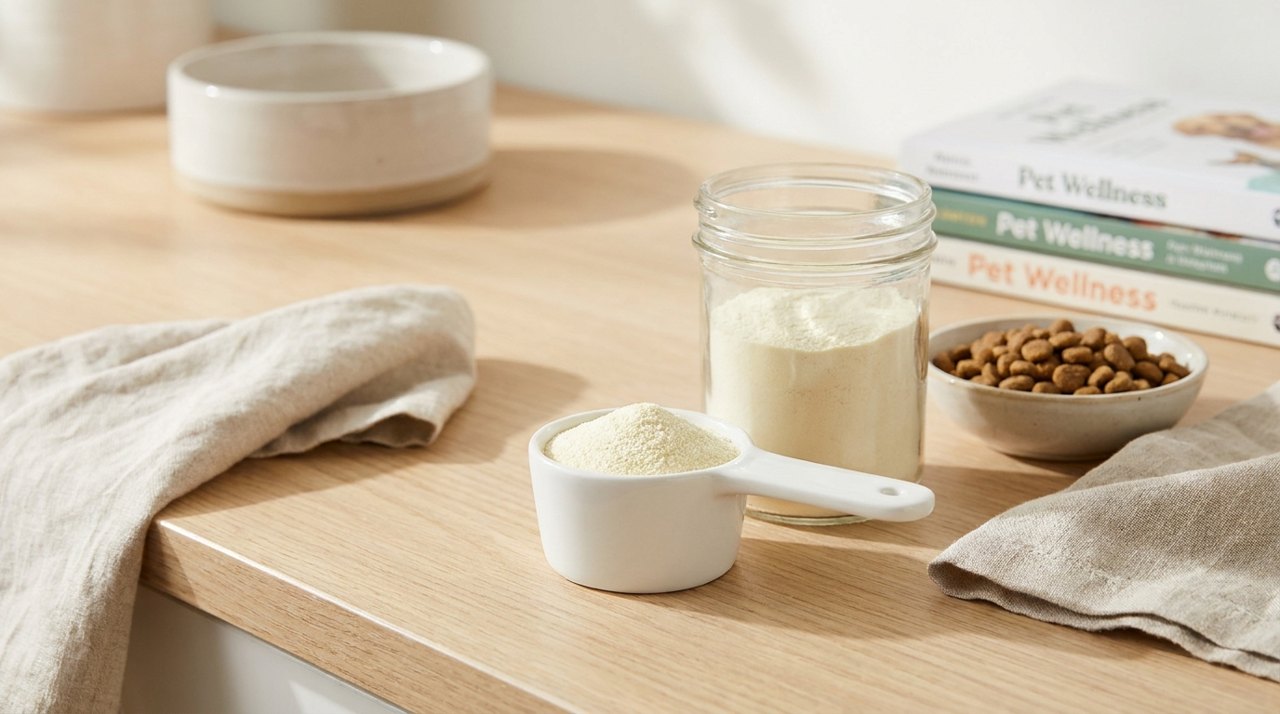
Most dogs get about 0.5–2 g of bovine colostrum powder a day (roughly ¼–1 teaspoon), and the products worth buying state their IgG content, typically 15–30%. The strongest canine evidence comes from a controlled feeding trial in which colostrum made up just 0.1% of the diet and was associated with higher fecal IgA, a stronger vaccine antibody response and a more stable gut microbiota. That is encouraging but limited: a handful of studies, mostly industry-funded, in healthy adult dogs. Below is what the numbers, the label and the price tag actually tell you before you add a tub to your cart.
Key takeaways
- Bovine colostrum is a dietary supplement for dogs, not a medicine; it has not been shown to treat, cure or prevent any canine disease.
- Two peer-reviewed dog trials (2004 and 2013) suggest modest benefits for stool quality and immune markers; both were small and funded by pet-food companies.
- Typical label doses are 0.5–2 g of powder per day, scaled to body weight; that adds only 2–8 kcal.
- Many "pet" colostrum products do not disclose IgG %. A human-grade powder with a stated 20–25% IgG is often cheaper per gram of immunoglobulin.
- Dairy is one of the three most commonly reported food allergens in dogs, so introduce colostrum slowly and stop if skin or gut signs appear.
- Bovine colostrum is not a substitute for a puppy's own mother's colostrum in the first 24 hours of life.
What bovine colostrum is and why dog owners use it
Bovine colostrum is the first milk a cow produces in the 1–3 days after calving. Compared with mature milk it carries far more protein (about 14 g per 100 mL versus 3.3 g), roughly 5–8 times more immunoglobulins, and concentrated lactoferrin, growth factors such as IGF-1 and TGF-β, and oligosaccharides. Once dried, a quality first-milking powder is about 60–75% protein, of which immunoglobulin G (IgG) makes up 15–30% of the powder by weight. For a fuller breakdown of composition, see what colostrum is.
Owners usually try it for one of four reasons: loose stools or sensitive digestion, seasonal or environmental itch, support for ageing dogs, or general "immune support". The evidence addresses the first and last of those far better than the middle two.
Shopping for colostrum? Our own brand is BIOMIXA grass-fed colostrum powder, direct from the maker.
What the canine research actually shows
Immune markers and vaccine response (Satyaraj et al., 2013)
In the most-cited dog study, researchers at Nestlé Purina fed adult dogs a standard diet with or without 0.1% spray-dried bovine colostrum. Over the trial the colostrum group showed higher fecal IgA (an antibody produced at the gut lining), a greater antibody rise after canine distemper virus vaccination, and less day-to-day fluctuation in the fecal microbiota. The authors interpreted this as support for gut-associated immune function. Two caveats: the dogs were healthy beagles in a research colony, and the sample was small. The dose is also striking for how low it was: 0.1% of a 300 g daily food ration is about 0.3 g, far below most retail label doses.
Stool quality (Giffard et al., 2004)
A Waltham study published in the Journal of Nutrition reported that dogs receiving bovine colostrum had firmer, more consistent feces than controls over several weeks. The effect was modest and the paper is a short conference-proceedings report rather than a full trial, so treat it as a signal, not proof.
What is missing
There are no published randomized trials of colostrum in dogs with diagnosed inflammatory bowel disease, atopic dermatitis, osteoarthritis or parvovirus. Claims on retail packaging about allergies, joints or "fighting infection" are extrapolated from rodent, calf and human work, which is reviewed on our benefits page. Some of that human literature (for example, on exercise-induced gut permeability) is reasonably solid, but species differences in gut pH, lactase activity and immune handling of bovine IgG mean it cannot be assumed to transfer.
How much to give: dose by body weight
There is no veterinary consensus dose. The ranges below reflect typical manufacturer labels and the published trial, expressed in grams because teaspoon measures vary by powder density (most colostrum powders weigh 2–2.5 g per level teaspoon).
| Dog weight | Typical label dose per day | Approx. IgG delivered at 20% IgG | Added energy |
|---|---|---|---|
| Under 10 kg (22 lb) | 0.5 g (¼ tsp) | 100 mg | ~2 kcal |
| 10–25 kg (22–55 lb) | 1 g (½ tsp) | 200 mg | ~4 kcal |
| 25–40 kg (55–88 lb) | 1.5–2 g (¾–1 tsp) | 300–400 mg | ~6–8 kcal |
| Over 40 kg (88 lb) | 2–3 g (1–1½ tsp) | 400–600 mg | ~8–12 kcal |
Start at half the listed amount for 5–7 days, mixed into food, then increase if stools stay normal. Powder is easier to scale for small dogs than capsules; a 500 mg capsule is already a full day's dose for a Chihuahua. General guidance on titration and interactions is on our dosage and safety page.
Comparing the product formats
The main decision is not brand but format and transparency. Prices below are approximate retail ranges at the time of writing and will vary by region.
| Format | IgG usually stated? | Typical IgG % | Approx. cost per gram of powder | Best for | Watch out for |
|---|---|---|---|---|---|
| Pet-labeled colostrum powder | Sometimes | Often undisclosed; 10–25% when stated | $0.15–0.40 | Convenience, dosing scoop sized for dogs | Fillers such as rice flour or whey; "proprietary blend" labels |
| Human-grade first-milking powder | Usually | 20–30% | $0.25–0.60 | Best value per mg of IgG; one tub for household and dog | Flavoured or sweetened versions; xylitol is toxic to dogs |
| Capsules (human or pet) | Usually | 20–30% | $0.40–1.00 | Travel, owners who dislike measuring | Hard to dose small dogs; higher cost |
| Soft chews or treats "with colostrum" | Rarely | Usually a minor ingredient | $1.00+ per gram of actual colostrum | Picky dogs | Colostrum may be 50–200 mg per chew behind glycerin, oats and flavourings |
| Complete diets with added colostrum | No | Typically ~0.1% of the kibble | Included in food price | Owners who want the trial-matched dose without a separate supplement | Cannot adjust the dose; limited range of brands |
For label-by-label comparisons of IgG, origin and price, see our brand comparison. If you want to understand why a 30% product is not automatically better than a 20% one, read the IgG percentage guide.
Reading the label: six checks before you buy
- Stated IgG percentage or mg per serving. If absent, assume the product is late-milking or diluted. First-milking (first 6–12 hours) colostrum has the highest IgG.
- Single-ingredient list. "Bovine colostrum" alone. Rice flour, maltodextrin, whey or "milk solids" lower the effective dose.
- No xylitol, chocolate flavour or added sweeteners. Xylitol causes dangerous hypoglycaemia in dogs even in small amounts; it appears in some human-grade flavoured powders.
- Processing method. Low-heat spray drying or freeze drying preserves more IgG than high-heat processing; pasteurisation alone typically costs 10–30% of IgG activity.
- Origin and antibiotic policy. Colostrum from cows treated with antibiotics around calving can carry residues; reputable suppliers test for them.
- Fat content. Full-fat powders (15–25% fat) spoil faster and matter for dogs prone to pancreatitis; defatted versions exist.
Note that "pet-only" does not mean higher quality. Pet supplements in the US are regulated as animal feed and face less labelling scrutiny than human dietary supplements, which is one reason some owners choose a human-grade powder and simply scale the dose down.
Safety, side effects and who should skip it
In the published dog trials, no adverse effects were reported at the doses used. In practice, the most common complaint from owners is soft stool or flatulence in the first week, which usually resolves at a lower dose. Colostrum powder contains lactose, though less than milk: roughly 10–15% by weight, so a 1 g serving delivers about 100–150 mg, well below what typically troubles adult dogs with reduced lactase activity.
The more important issue is dairy sensitivity. In a 2016 review of reported food allergens in dogs, dairy products ranked among the three most frequently implicated sources, alongside beef and chicken. If your dog has a confirmed or suspected dairy or beef allergy, colostrum is a poor choice. Dogs on elimination diets should not receive it until the diet trial is complete.
Three further cautions. First, colostrum contains bioactive growth factors; while there is no evidence of harm in dogs, owners of dogs with a cancer diagnosis should ask their veterinary oncologist before using it. Second, the bovine IgG in colostrum acts locally in the gut and is mostly digested; it is not absorbed to provide systemic immunity in a weaned dog. Third, bovine colostrum cannot replace a dam's colostrum for newborn puppies. Puppies have an endotheliochorial placenta and get almost all their passive immunity from nursing in the first 24 hours; an orphaned neonate needs veterinary care and, where indicated, plasma or serum from a vaccinated adult dog, not a dairy supplement.
FAQ
Can I give my dog the same colostrum powder I take?
Usually yes, provided it is a plain, unflavoured, single-ingredient powder with a stated IgG percentage. Check the ingredient list for xylitol, cocoa, stevia blends or added probiotics and omega oils, and scale the dose to body weight rather than using the human scoop. Human-grade powders are often the better value per milligram of IgG compared with pet-labelled products.
How long before I should expect to see anything?
The published dog trials ran for several weeks before measuring outcomes. For stool quality, owners commonly report changes within 1–3 weeks; immune-marker changes are not something you can observe at home. If nothing has changed after 6–8 weeks at a stable dose, there is little reason to continue, and the money is probably better spent on a diagnostic work-up with your veterinarian.
Is more IgG always better for dogs?
Not necessarily. The one canine trial showing immune effects used about 0.3 g of ordinary colostrum per day, not a high-IgG concentrate. IgG percentage matters mainly for judging whether a product is genuine first-milking colostrum and for comparing price per milligram. Above roughly 20–25%, the practical difference at dog-sized doses is small.
Can colostrum be given with other supplements or medications?
There are no documented interactions in dogs, but there is also very little data. Because it is a dairy protein given with food, timing it away from medications that should be given on an empty stomach, such as some thyroid or antibiotic tablets, is sensible. Always tell your veterinarian what supplements your dog receives so they can factor it into any diagnosis.
Sources
- Satyaraj E, Reynolds A, Pelker R, Labuda J, Zhang P, Sun P. Supplementation of diets with bovine colostrum influences immune function in dogs. British Journal of Nutrition, 2013;110(12):2216–2221.
- Giffard CJ, Seino MM, Markwell PJ, Bektash RM. Benefits of bovine colostrum on fecal quality in dogs. Journal of Nutrition, 2004;134(8 Suppl):2144S–2146S.
- Mueller RS, Olivry T, Prélaud P. Critically appraised topic on adverse food reactions of companion animals (2): common food allergen sources in dogs and cats. BMC Veterinary Research, 2016;12:9.
- Playford RJ, Weiser MJ. Bovine colostrum: its constituents and uses. Nutrients, 2021;13(1):265.
- Ulfman LH, Leusen JHW, Savelkoul HFJ, Warner JO, van Neerven RJJ. Effects of bovine immunoglobulins on immune function, allergy, and infection. Frontiers in Nutrition, 2018;5:52.
BIOMIXA Bluegrass Colostrum
A single-ingredient, grass-fed, unflavored colostrum powder (stated IgG of at least 25%) from the team behind this site. See how it compares in our 9-brand price and IgG comparison. Sold direct by the maker at biomixa.com.
Disclosure: BIOMIXA is our own brand — this site is run by the makers of BIOMIXA colostrum. We also earn a commission on Amazon purchases. Full disclosure.