First-Milking Colostrum: What the Label Claim Means and Whether It Matters
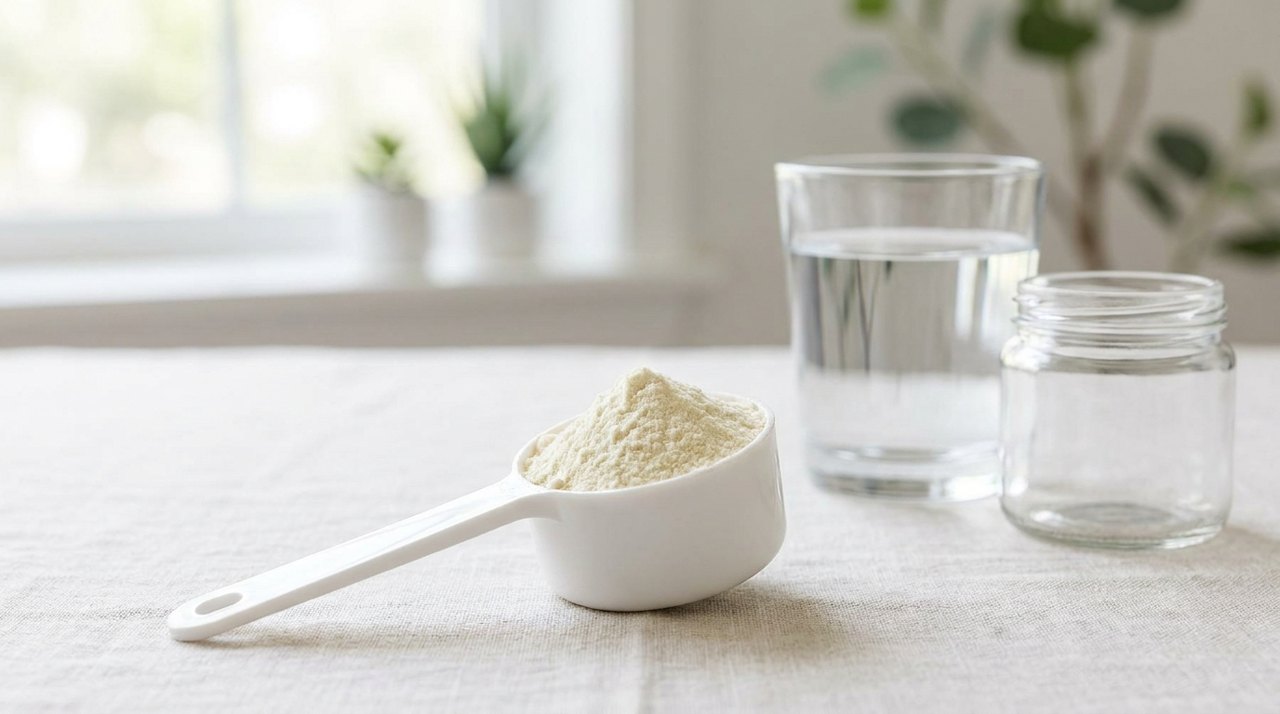
"First-milking colostrum" is one of the most common claims on bovine colostrum labels, and one of the least defined. It suggests a premium product collected in the first hours after calving, when antibodies are at their highest. The biology behind that idea is real. The label itself is not standardized, though, and it tells you less than the IgG figure printed on the same tub. This article explains what the claim can mean, what the dairy science shows, and how to judge whether it matters for your purchase.
Key takeaways
- In dairy cows, the first milking after calving usually has the highest immunoglobulin G (IgG). Levels often fall by roughly half by the second milking and keep dropping over the next few days.
- "First milking" has no legal or industry-wide definition for supplements. Brands may use it for colostrum collected within 6, 12, 24 or even 48 hours.
- First-milking colostrum varies a lot from cow to cow. Studies of US dairy farms found IgG ranging from under 10 g/L to over 200 g/L.
- A verified IgG percentage per serving, backed by a third-party certificate of analysis, is a more useful number than the "first milking" phrase.
- No human studies show that "first-milking" products give better outcomes than standardized colostrum from later collections.
What "first milking" means biologically
Colostrum is the secretion a cow produces in the first days after calving. Cow placentas don't pass antibodies to the calf, so newborn calves rely on colostrum for passive immunity. To serve that purpose, the mammary gland concentrates IgG and other proteins before birth. The first milking draws off that stored reserve. Each milking after it is diluted by rising milk volume and contains fewer immune proteins. For a general overview, see our page on what colostrum is.
Timing matters even within the first milking. Moore and colleagues (2005) found lower IgG in colostrum collected about 6, 10 or 14 hours after calving than in colostrum collected about 2 hours after. Their suggested explanation was dilution as milk production starts. So "first milking" taken at 2 hours and "first milking" taken at 14 hours are not equivalent, even though both would be described honestly.
How composition changes over the first few days
The figures below are approximate averages from classic dairy-science data, widely reproduced in veterinary reviews. Individual cows vary considerably.
| Milking | Total solids (%) | Protein (%) | Fat (%) | Lactose (%) | IgG (g/L, approx.) |
|---|---|---|---|---|---|
| 1st milking (colostrum) | ~24 | ~14 | ~6.7 | ~2.7 | ~30–80+ |
| 2nd milking (transition) | ~18 | ~8.4 | ~5.4 | ~3.9 | ~25 |
| 3rd milking (transition) | ~15 | ~5.1 | ~3.9 | ~4.4 | ~15 |
| Mature milk | ~12.9 | ~3.1 | ~4.0 | ~5.0 | ~0.6 |
The trend is clear: protein and IgG fall steeply while lactose rises toward normal milk levels. That trend is the scientific basis for the first-milking claim.
Shopping for colostrum? Our current best-value pick is BIOMIXA grass-fed colostrum powder on Amazon.
The variability problem
The trend is clear, but individual cows vary widely around it. In a US study of 827 samples from dairy farms in 12 states, Morrill and colleagues (2012) found an average colostrum IgG of about 69 g/L, with a very wide range. A meaningful share of samples fell below the 50 g/L threshold farms use to define "good" colostrum for calves. Kehoe and colleagues (2007) reported similarly large variation on Pennsylvania farms.
Several factors may affect IgG concentration:
- Parity: cows in their third or later lactation tend to produce more concentrated colostrum than first-calf heifers.
- Volume: cows that produce large volumes at first milking often have more diluted IgG.
- Breed, season and dry-period management can each shift values.
- Collection delay: as noted above, the hours between calving and milking matter.
A single cow's second milking can therefore have more IgG than another cow's first milking. Commercial colostrum is pooled from many animals, so the averages even out. Still, the "first milking" label alone doesn't guarantee a particular potency.
What the label claim may (and may not) tell you
Neither the US FDA nor most other regulators define "first-milking colostrum" for dietary supplements. In practice, companies use the phrase in several ways:
- Strict first milking: only the first collection after calving, sometimes with a stated time window such as "within 6 hours".
- First 24 hours: may include the first and second milkings.
- First 48–72 hours: effectively a mix of colostrum and transition milk. This is sometimes marketed with wording that implies first milking.
There is also an ethical and practical issue. Good dairy practice prioritizes feeding first-milking colostrum to the newborn calf, often 3–4 litres within the first few hours (Godden et al., 2019). Many reputable suppliers state that they collect only surplus colostrum after the calf's needs are met. Ask any brand that advertises strict first milking how it squares that claim with calf welfare.
What matters more: verifiable numbers
Raw colostrum is pooled, pasteurized, sometimes defatted, and dried, so the final powder's composition is what you actually consume. These details are more informative than the collection claim:
- IgG percentage: commercial powders commonly state 15–40% IgG. In a 2 g serving, that is roughly 300–800 mg of IgG.
- Test method: radial immunodiffusion (RID) and validated HPLC methods are the usual approaches. Results from different methods aren't always directly comparable.
- Certificate of analysis: ideally from a third-party lab, covering IgG, microbial counts and contaminants.
- Processing temperature: heat treatment can denature some bioactive proteins. Low-temperature pasteurization claims are worth asking about.
- Defatting: defatted powders have a higher protein and IgG percentage by weight and fewer calories.
For energy content, colostrum powder generally provides around 4 kcal per gram. A typical 2–3 g serving is therefore only about 8–12 kcal. Larger research doses of 20 g per day would add roughly 80 kcal, mostly from protein. Our guide to choosing a colostrum supplement goes through label reading step by step.
A simple comparison
| Label feature | What it tells you | Verifiable? | Usefulness |
|---|---|---|---|
| "First milking" (no time window) | Marketing intent; collection details unclear | Rarely | Low |
| "Collected within X hours" | Specific collection window | Sometimes, via supplier audit | Moderate |
| Standardized IgG % (e.g., 30%) | Actual antibody content of the powder | Yes, via certificate of analysis | High |
| Third-party testing | Independent check on potency and purity | Yes | High |
Does it matter for human outcomes?
This is where the evidence runs out. Human studies of bovine colostrum have looked at outcomes such as gut permeability during heavy exercise and upper respiratory symptoms in athletes. These trials are generally small, use standardized commercial products, and report mixed results (Playford & Weiser, 2021). As far as we know, no controlled human trial has compared "first-milking" colostrum with later-collection colostrum at matched IgG doses. Any claim that first-milking products work better in people is, for now, an extrapolation from dairy-calf biology.
It is plausible that a more concentrated starting material produces a more potent powder. However, a product standardized to a stated IgG level already accounts for that. Bovine colostrum is a dietary supplement. It is not shown to treat, cure or prevent any disease. For typical intake ranges and who should be cautious, such as people with cow's-milk allergy, see our page on dosage and safety.
FAQ
Is first-milking colostrum always higher in IgG?
On average, yes. The first milking usually has much more IgG than later milkings from the same cow. Individual cows vary a lot, though, and how long after calving the milk is collected also matters. A pooled powder standardized to a stated IgG percentage tells you more about potency than the "first milking" claim alone.
Does taking first-milking colostrum deprive calves?
It can if handled poorly, because newborn calves depend on first-milking colostrum for passive immunity. Responsible dairies feed calves first and sell only the surplus. If welfare matters to you, ask the brand directly about its calf-first policy and collection practices. Look for specific answers rather than general reassurances.
Is "first 24 hours" colostrum inferior?
Not necessarily. "First 24 hours" colostrum may include a second milking with lower IgG. But if the final powder is tested and standardized to a clear IgG percentage, you know what you're getting. A first-24-hour product with verified 30% IgG may be more useful than a vague "first milking" product with no reported IgG figure.
What IgG percentage should I look for?
Many reputable powders state 20–30% IgG, and some defatted products claim up to around 40%. Higher isn't automatically better for every use, and the research supporting specific human doses is limited. Choose a stated, independently tested figure over marketing language, and compare the cost per gram of IgG rather than per gram of powder.
Sources
- Moore M, Tyler JW, Chigerwe M, Dawes ME, Middleton JR. Effect of delayed colostrum collection on colostral IgG concentration in dairy cows. Journal of the American Veterinary Medical Association, 2005.
- Morrill KM, Conrad E, Lago A, Campbell J, Quigley J, Tyler H. Nationwide evaluation of quality and composition of colostrum on dairy farms in the United States. Journal of Dairy Science, 2012.
- Kehoe SI, Jayarao BM, Heinrichs AJ. A survey of bovine colostrum composition and colostrum management practices on Pennsylvania dairy farms. Journal of Dairy Science, 2007.
- Godden SM, Lombard JE, Woolums AR. Colostrum management for dairy calves. Veterinary Clinics of North America: Food Animal Practice, 2019.
- Playford RJ, Weiser MJ. Bovine colostrum: its constituents and uses. Nutrients, 2021.
BIOMIXA Bluegrass Colostrum
A grass-fed, unflavored colostrum powder that balances quality and price well — our pick for the best bang for your buck. Check the current price and reviews on Amazon.
Disclosure: BIOMIXA is our own brand — this site is run by the makers of BIOMIXA colostrum. We also earn a commission on Amazon purchases. Full disclosure.